Historical report: PANews published this ChainCatcher account by Zhou on November 7, 2026, at 13:30 Beijing time. The prices and expectations below reflect that reporting period, not current market conditions.
ChainCatcher reported that a November 5 sell-off in US technology shares spread to Bitcoin, crypto-linked stocks and Asian markets. Its account tied the shift in sentiment to investors reassessing AI data-center construction after Democrats won both chambers of Congress and several governorships. That is a reported explanation for the market move—not evidence that any proposed restriction on data-center construction had become law.
Bitcoin’s reversal and the leverage behind it
According to the report, Bitcoin rose above $80,000 after the election result became clear on Wednesday, November 4, before falling below $76,000 on Thursday. Citing CoinGecko, ChainCatcher said Bitcoin dropped from $78,767 to $75,986 within one hour as the Nasdaq fell. Ether briefly slipped below $2,250. Bitcoin’s roughly 6% decline on Thursday was close to the Nasdaq Composite’s 5.52% fall and the Nasdaq 100’s 6.36% fall, though smaller than the Philadelphia Semiconductor Index’s 12.25% drop.
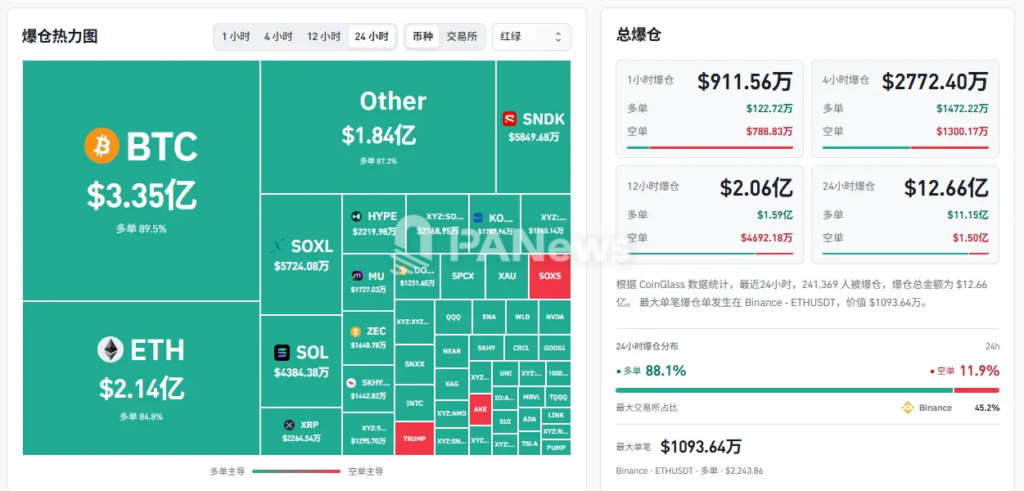
The reversal was especially costly for leveraged positions. CoinGlass data cited in the article put 24-hour crypto liquidations at $1.251 billion, including $1.108 billion in long positions—88.6% of the total—and 239,896 affected traders. The same account said liquidations in stock-linked perpetual contracts for SNDK and SOXL reached $58.32 million and $56.71 million, respectively, each exceeding SOL’s $43.25 million. These figures describe the reported unwind; they do not establish a single cause for every liquidation.
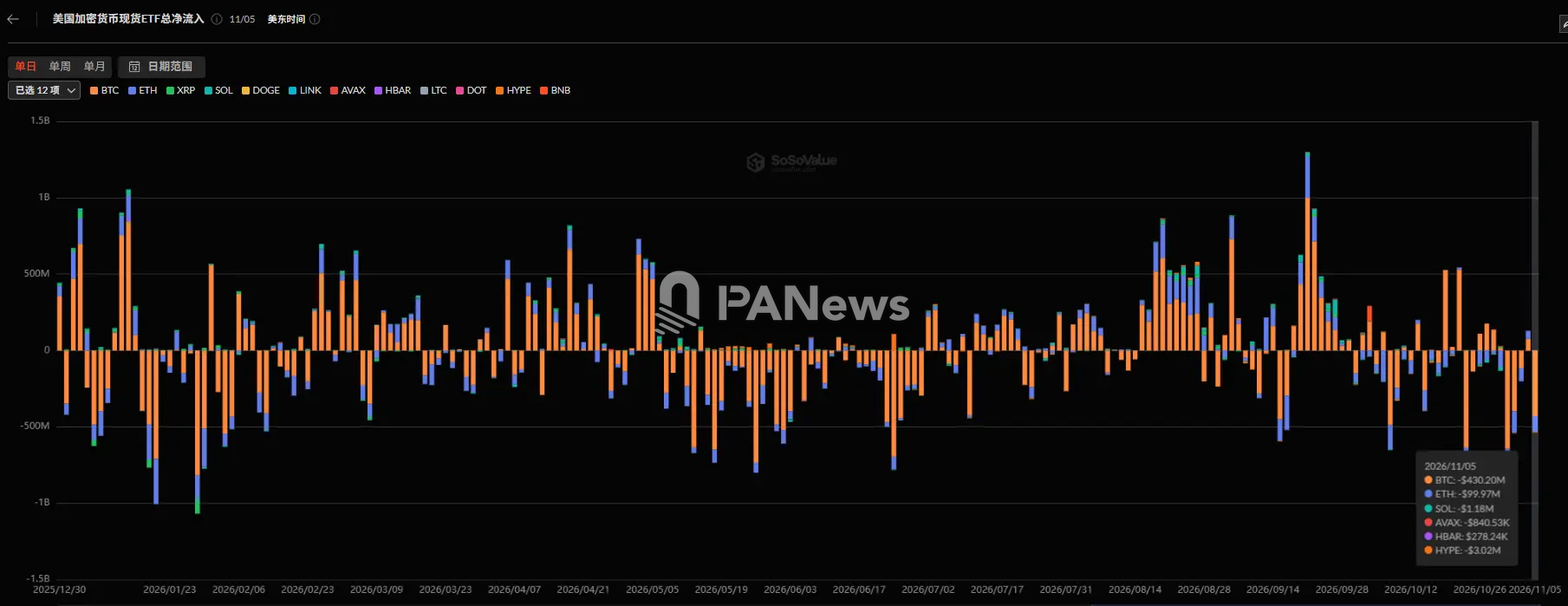
Spot-fund flows had weakened before Thursday’s drop. SoSoValue data cited by ChainCatcher showed $430 million in net outflows from US spot Bitcoin ETFs on November 5, with none of the 12 funds recording a net inflow. Their combined net assets fell from $102.26 billion to $96.65 billion. Across the five trading days beginning October 30, the funds recorded approximately $1.51 billion in net outflows, with November 4 the only inflow day. The report also put November 5 spot Ether ETF net outflows at $99.97 million.
Why AI-exposed miners drew attention
ChainCatcher described a sharp change in equity-market sentiment: the S&P 500 had gained nearly 2% and the Dow more than 3% on Wednesday, before falling 4.36% and 3.44%, respectively, on Thursday. Semiconductor shares led that decline. Friday’s weakness extended into Asia; the report said a trading halt was triggered in South Korea after the KOSPI fell sharply.
The proposed policy risk was specific. ChainCatcher said Texas governor-elect Gina Hinojosa had advocated an immediate pause on new data centers. UBS estimated that about 30% of planned additions to US data-center capacity for 2028 could be affected by potential construction pauses. Neither a governor-elect’s position nor that estimate amounts to an enacted nationwide moratorium.
That uncertainty mattered to Bitcoin miners that had been converting facilities for AI computing. The report said Bernstein cut price targets for seven miners, citing tighter financing and uncertainty in Texas, and identified IREN, Riot and Cipher as having the greatest Texas exposure among companies it covered. On Thursday, ChainCatcher recorded declines of 18.68% for Bitdeer, 16.95% for IREN, 16.47% for CleanSpark, 14.62% for Cipher, 14.48% for MARA and 13.85% for TeraWulf. Falling Bitcoin prices and doubts about AI infrastructure were two risks investors were weighing, not a verified breakdown of what caused each stock’s loss.
Events the report said investors were watching
At publication, the article identified a possible Anthropic IPO roadshow during the week of November 9 and Nvidia’s planned November 17 earnings release as upcoming tests of AI-market sentiment. Reuters, citing four people familiar with the matter, reported doubts that Anthropic would keep its proposed timetable if AI-related assets remained under pressure. The Wall Street Journal reported that three prospective investors questioned whether it could reach an earlier $1.5 trillion valuation expectation. Those were investor expectations and reported doubts, not an IPO date or valuation achieved.
The report separately described a possible slowdown in US crypto legislation. It said French Hill was expected to relinquish the House Financial Services Committee chairmanship in January, with Maxine Waters a leading prospective successor, while Elizabeth Warren was expected to lead the Senate Banking Committee. Those leadership changes were prospective at the time of publication. ChainCatcher noted that the CLARITY bill had failed to advance in a September Senate procedural vote, 49–50, and attributed its impasse over proposed ethics provisions to Bloomberg. Analysts quoted in the report expected further delays, but their forecasts were not legislative outcomes.
The clearer takeaway from this historical account is the exposure, not a promised next move: a Bitcoin sell-off coincided with a technology-stock reversal, ETF outflows and heavy long liquidations, while the policy and AI events cited as possible catalysts remained unresolved when the article was published.
Source: panewslab.com (originally published 2026-11-07 13:30 UTC+8)