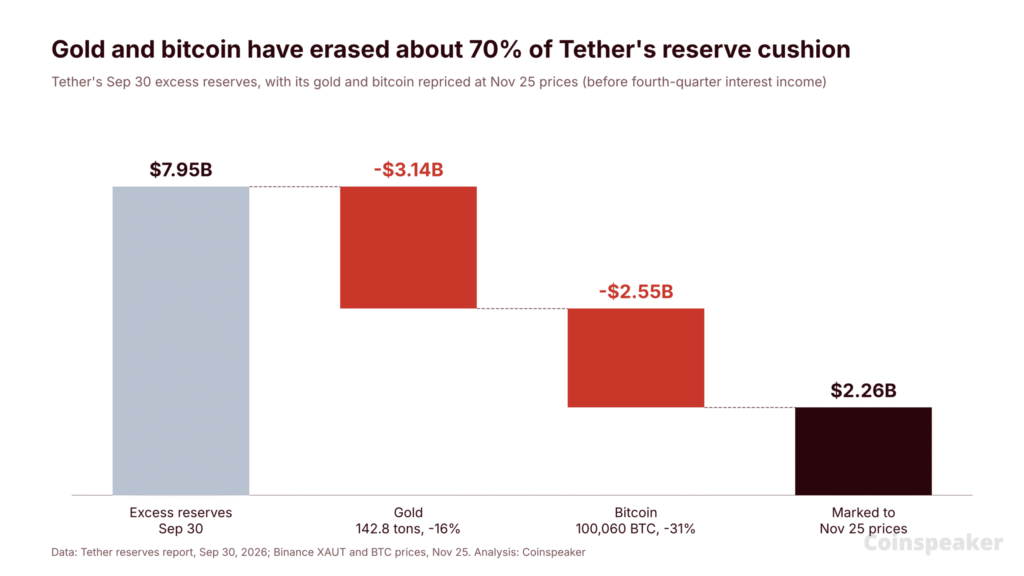
Coinspeaker’s analysis, published on November 26, 2026, at 00:24:06 UTC+8, estimated that gold and Bitcoin price declines had reduced the value of two holdings in Tether’s USDT reserves by $5.69 billion. That was about 70% of the $7.95 billion by which Tether’s assets exceeded its liabilities on September 30. The calculation used November 25 prices; it was not a new reserve figure reported by Tether.
What the estimate counts
Tether’s September 30 reserve report valued its gold bars at $19.08 billion at $4,157.41 an ounce, implying holdings of about 4.59 million ounces, or 142.8 tons. Using the November 25 price of $3,473 for Tether Gold (XAUT) as the price per ounce reduced the estimated value of those bars by $3.14 billion.
The calculation excludes the gold backing XAUT itself. The token’s Ethereum contract showed 827,418 XAUT outstanding on November 25, each representing one ounce. Those 25.7 tons, worth about $2.9 billion, belong to token holders. They count toward the roughly 168 tons across the two pools, but not toward USDT’s reserve surplus.
Tether also held about 100,060 BTC, valued at $83,621 each on September 30. Repricing them at $58,109 implied a further $2.55 billion decline. Holding everything else constant, the two adjustments would leave a surplus of about $2.26 billion.
Everything else need not have stayed constant. Tether earned interest on $122.8 billion of US Treasury bills and reported profits of $1.04 billion and $1.5 billion in the first and second quarters of 2026, respectively. Fourth-quarter income could offset some of the decline. In the other direction, Tether’s $4.18 billion stock portfolio, which its report said included gold and Bitcoin exposure, may also have lost value.
USDT supply fell $16 billion from its May peak
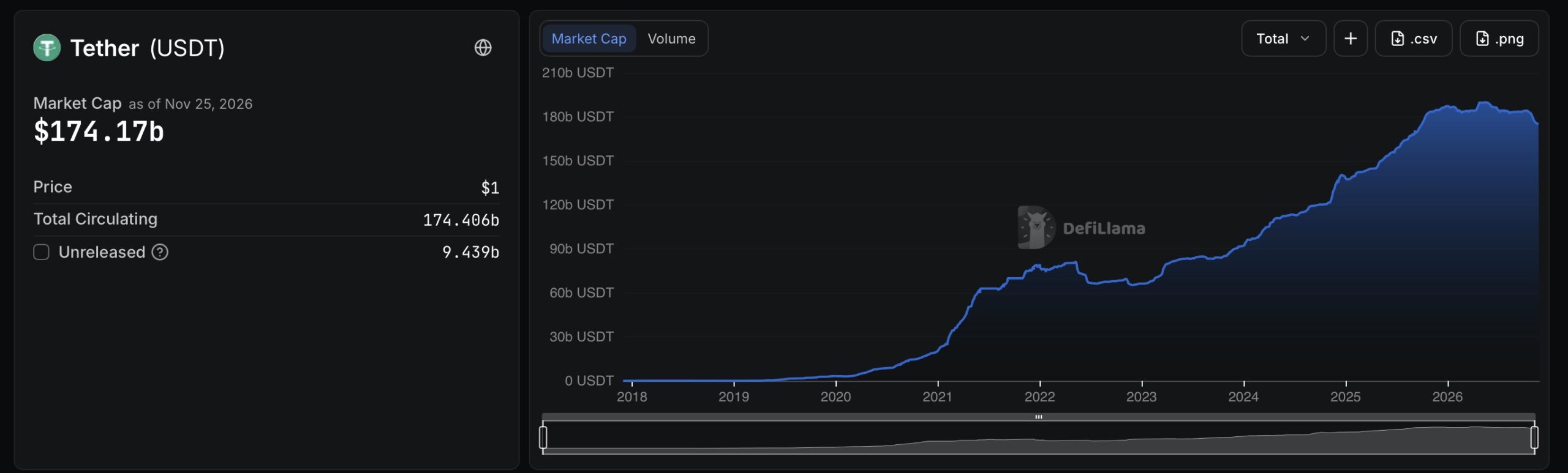
DefiLlama figures showed USDT supply at $174.4 billion on November 25, down from a May 20 peak of $190.4 billion. About $9.4 billion had been redeemed since September 30, a 5% decline. Supply fell on most days in November from $179.8 billion on November 1. Redemptions reduce the pool of Treasury bills on which Tether can earn interest; they are distinct from the estimated investment losses.
Why the gold chart uses PAXG
US gold futures closed at $3,503 an ounce on November 25, down 10% from November 12 and 37% below the January 28 record of $5,589. Silver futures fell 21% over the same November period to $39.58. The dollar and bond yields had risen as traders anticipated a rate increase at the Federal Reserve’s December 8–9 meeting. Kitco’s November 24 market report put the odds near 95%; the Fed had not yet made that decision.
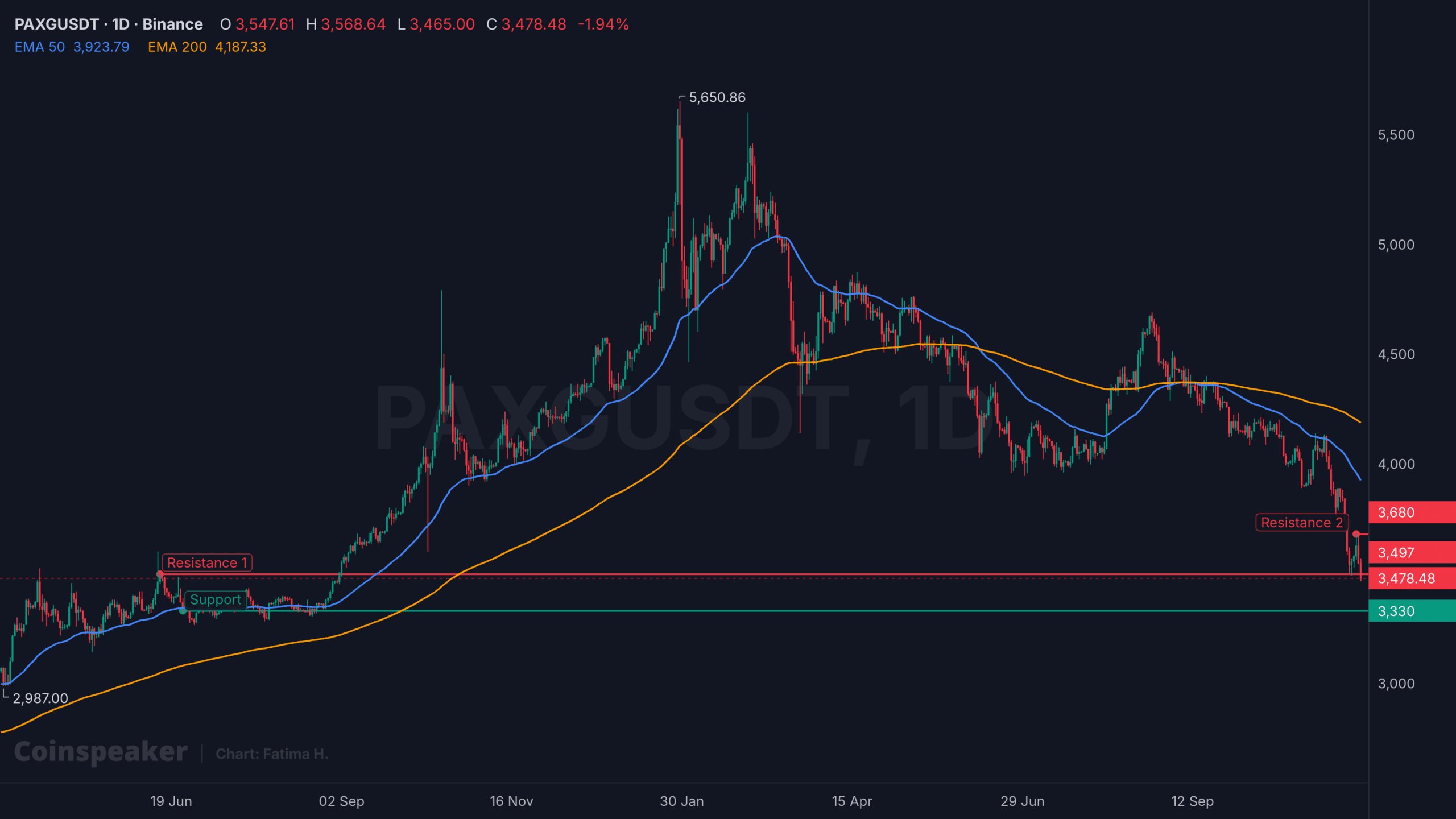
For its technical analysis, Coinspeaker used PAX Gold (PAXG), another token tracking one ounce of gold, because its Binance price history extended further back than XAUT’s March listing. PAXG traded at $3,478, below its 50-day exponential moving average of $3,924 and its 200-day average of $4,187.
The analysis identified $3,497 as resistance: a ceiling in June 2025, it had acted as a floor on November 20 and 21 before giving way on November 25. A daily close back above it would bring $3,680 into view, a level gold tokens had failed to clear on November 23 and 24. A close below $3,465 would shift attention to $3,330, a floor from June through August 2025. Between $3,465 and $3,497, the analysis described a holding pattern ahead of the Fed meeting. These were conditional chart readings, not forecasts of Tether’s reserve balance.