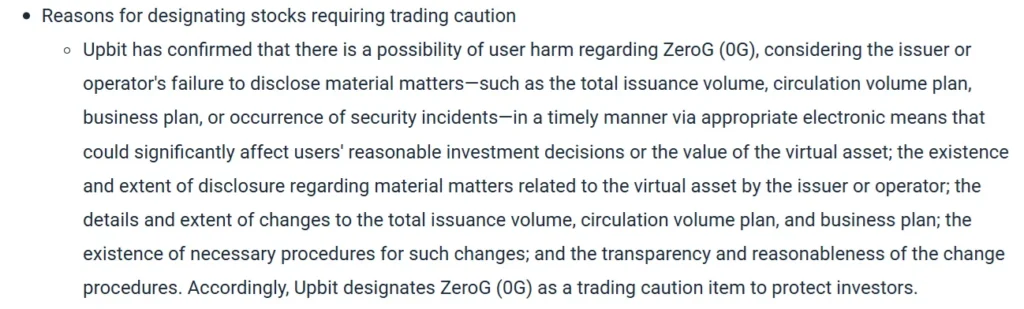
The 0G Foundation promised to address “discrepancies” in a November 24, 2026, statement on X, hours after Upbit suspended deposits of its token. The foundation did not say what those discrepancies were. Upbit was more specific: South Korea’s largest crypto exchange flagged disclosures about total token issuance, the circulation schedule, business plans and security.
Upbit designated 0G a “trading caution item” and named all three of its markets for the token: 0G/KRW, 0G/BTC and 0G/USDT. The exchange suspended deposits, not trading. It warned that tokens sent after the 3 p.m. Korea Standard Time cutoff (6 a.m. UTC) on November 24 might not be credited and could be unrecoverable.
What Upbit questioned
Citing Article 17 of the Enforcement Decree of South Korea’s Virtual Asset User Protection Act, Upbit said it found a “possibility of user harm.” Its review examined whether investors received material information promptly and how clearly the project explained changes to token supply and business plans. The foundation acknowledged Korean holders’ concerns and pledged to strengthen its disclosure process, but its response did not address the four areas individually.
One change relevant to the review was the September 2026 revision to the unlock schedule. Early investors and team members were allocated 44% of a planned 1 billion tokens. The project moved their first unlock from October 22, 2026, to October 22, 2027, while shortening the remaining vesting period from 36 months to 24. The release would start a year later but proceed faster once it began.
Published supply figures also leave a question unanswered. CoinMarketCap listed total supply at 1.09 billion tokens and maximum supply as uncapped. The project put circulating supply near 600 million and framed its unlock schedule around a 1 billion-token cap. Circulating supply and total supply are different measures; the foundation’s response did not explain how the schedule’s cap fits the reported total. On security, the project lost roughly $520,000 in a December 2025 hack, but Upbit’s stated concern did not establish that the incident prompted the designation.
What the December review could mean
Upbit gave December 21–24 as the end of its warning period. It can lift the designation, extend the review or terminate trading support if the issues remain unresolved. In September, Upbit removed BONK after concluding that the problems it flagged had not been fixed, while rival Korean exchange Bithumb allowed BONK trading to resume. Neither decision determines the outcome for 0G.
The stakes extend beyond Korean token holders. The OECD’s Asia Capital Markets Report 2026 ranked South Korea near the top in Asia for absolute crypto inflows. Losing access to its largest exchange would also matter to ZeroStack, the Nasdaq-listed 0G treasury company formerly known as cannabis firm Flora Growth. ZeroStack holds 75.1 million 0G tokens and funds operations by selling tokens and staking rewards. It had already warned of substantial doubt about its ability to stay in business over the following year. Its cash runway depends on both the token’s price and its ability to sell its holdings.
CoinMarketCap put 0G at about $0.1058 on November 24, down roughly 2% on the day, with a market capitalization near $63.5 million. That price was about 98.5% below its September 22, 2025, peak of $7.31. The token had touched a record low of $0.103 on November 21, three days before Upbit’s notice.