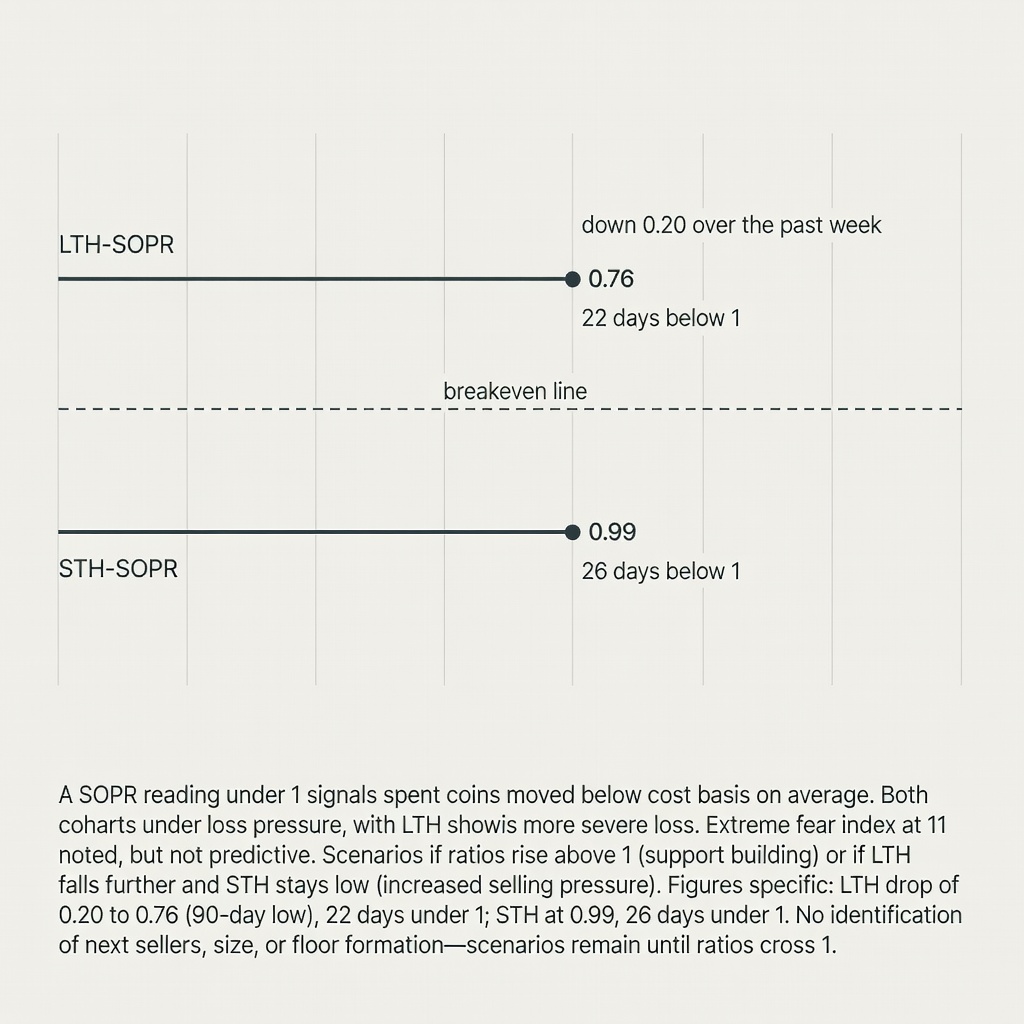
Jinse Finance reported on November 24, 2026, that CryptoQuant analyst Axel Adler said Bitcoin’s long-term holder spent output profit ratio (LTH-SOPR) had fallen 0.20 over the prior week to 0.76. He called that a 90-day low and one of the lower readings of the past year, and said the ratio had stayed under the breakeven line of 1 for 22 consecutive days.
Short-term holders, still under 1
In the same post, Adler put the short-term holder SOPR (STH-SOPR) at 0.99, below 1 for 26 consecutive days. On his reading, bitcoin moved by short-term holders was still being realized at a loss in aggregate. The report’s account of the note says both cohorts were under loss pressure, with long-term holders showing the more severe loss.
A SOPR reading under 1 is the metric’s signal that spent coins changed hands below cost basis, on average. It describes coins that moved. It is not, by itself, a confirmed path for the next price.
Extreme fear, and two conditions that are not results
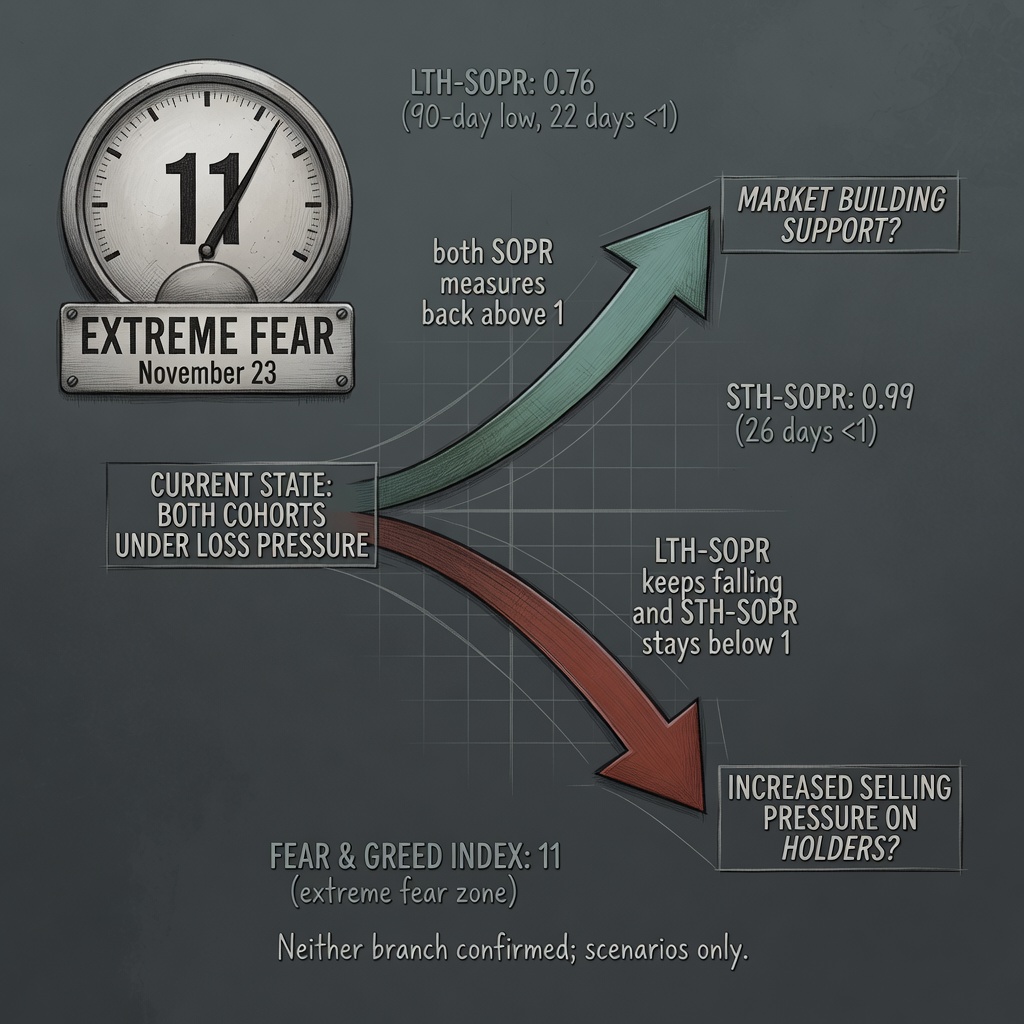
The report also noted that the crypto Fear and Greed Index stood at 11 on November 23, in the extreme-fear zone. That is a sentiment print from the day before the SOPR note, not evidence that selling must speed up or stop.
The analysis then offers conditions, not outcomes. If both ratios move back above 1, it argues, that would help confirm the market is building support. If LTH-SOPR keeps falling and STH-SOPR stays below 1, selling pressure on holders could increase further. Neither branch is shown to have happened.
What the note does not settle
The figures attributed to Adler are specific: a 0.20 weekly drop in LTH-SOPR to 0.76, 22 days under 1 for long-term holders, and 26 days under 1 for short-term holders at 0.99. They do not identify who sells next, in what size, or whether a floor is forming. Until those ratios are back above 1 — or are not — both the support claim and the heavier-selling claim remain scenarios.