
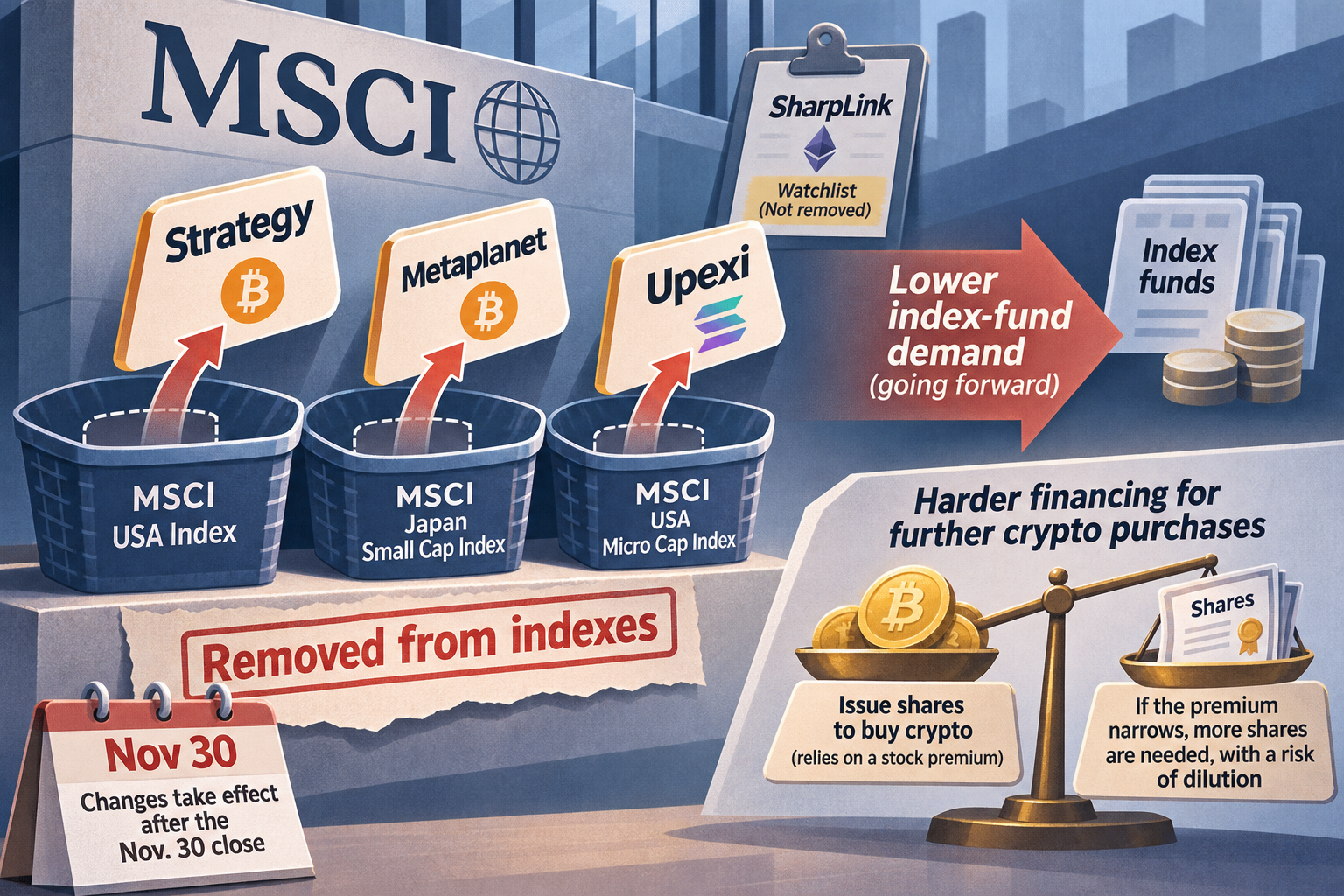
As reported on November 12, 2026, MSCI’s November index review removed Strategy, Metaplanet and Solana treasury company Upexi from their respective indexes. The changes are scheduled to take effect after the November 30 close. For Bitcoin-adjacent treasury stocks, the question is not whether an index decision forces a coin sale—it does not—but how losing index-linked demand could affect future fundraising.
Strategy will leave the MSCI USA Index, Metaplanet the MSCI Japan Small Cap Index, and Upexi the MSCI USA Micro Cap Index. All three had appeared on potential-deletion lists. Ether treasury company SharpLink remained on a watchlist and was not included in this round of removals.
Why MSCI removed them
In 2025, MSCI proposed excluding treasury companies whose digital assets made up at least 50% of total assets. That proposal was not implemented in January 2026. MSCI instead broadened its review to cover “non-operating companies” across asset classes, adopted a new framework on October 15 and applied it in the November review.
The framework first examines operating assets, then considers measures including operating expenses, operating cash flow, fair-value changes and reliance on external financing. An existing constituent is removed if it fails the screening in both of its two most recent annual reporting periods. Under that test, retaining another business does not necessarily preserve index eligibility.
Selling pressure is a possibility, not a measured outcome
Funds tracking the affected indexes will need to adjust their holdings. In an earlier consultation response, Strategy said funds tracking MSCI’s Global Investable Market Indexes held approximately 13 million MSTR shares, or 3.1% of its basic share capital. At the November 10 closing price of $121.07, those shares were worth about $1.57 billion. That holding figure is not a forecast of how many shares will be sold.
JPMorgan estimated in 2025 that MSCI removal could prompt roughly $2.8 billion of Strategy selling, potentially rising to $8.8 billion if other major index providers followed. Strategy, for its part, said the 13 million shares represented about 60% of its 30-day average daily trading volume and did not expect a material impact. Trading volume alone cannot establish what the price impact of rebalancing will be.
Metaplanet CEO Simon Gerovich said the change would not materially affect the company’s business or Bitcoin strategy. Upexi had not publicly commented on the removal as of the original report. Their potential selling pressure cannot be inferred from Strategy’s figures; it depends on their own fund ownership and share liquidity.
The longer-running question is financing. Index exit removes a source of prospective passive buying, even after any rebalancing is over. Treasury companies that issue shares to buy more crypto assets depend in part on investors paying a premium to the assets attributable to each share. If that premium narrows, raising the same amount requires more shares; issuing below per-share net asset value could dilute existing holders. MSCI’s decision does not require any of the three companies to sell their crypto holdings, but it may make the economics of financing further purchases less favorable.