
In a report published November 17, 2026, Decrypt said Bitcoin had fallen to around $62,100 on Sunday, its lowest level since July 14, before recovering to roughly $64,300 early Monday. The drop followed six consecutive weeks of losses. The immediate risk was not just the price move, but the leveraged bets it forced closed.
CoinGlass figures cited in the report showed $1.9 billion in crypto-wide liquidations in one 24-hour period on Saturday. About $1.8 billion involved bullish positions. Those figures cover cryptocurrencies broadly, not Bitcoin alone, and describe positions exchanges closed when traders’ collateral could no longer cover their losses.
ETF withdrawals preceded the weekend drop
U.S. spot Bitcoin ETFs recorded $185.4 million in net outflows on Friday, according to Decrypt’s ETF tracker. That marked a seventh consecutive trading session of outflows and brought the total since November 5 to approximately $1.91 billion. BlackRock’s IBIT accounted for $143.5 million of Friday’s outflows, and Fidelity’s FBTC for $41.9 million.
The timing matters: U.S. ETFs were not trading during Sunday’s Bitcoin decline. Friday’s fund flows showed weaker demand beforehand, not ETF shareholders redeeming shares during the weekend plunge. Net flows also measure fund creations and redemptions, rather than every trade between investors.
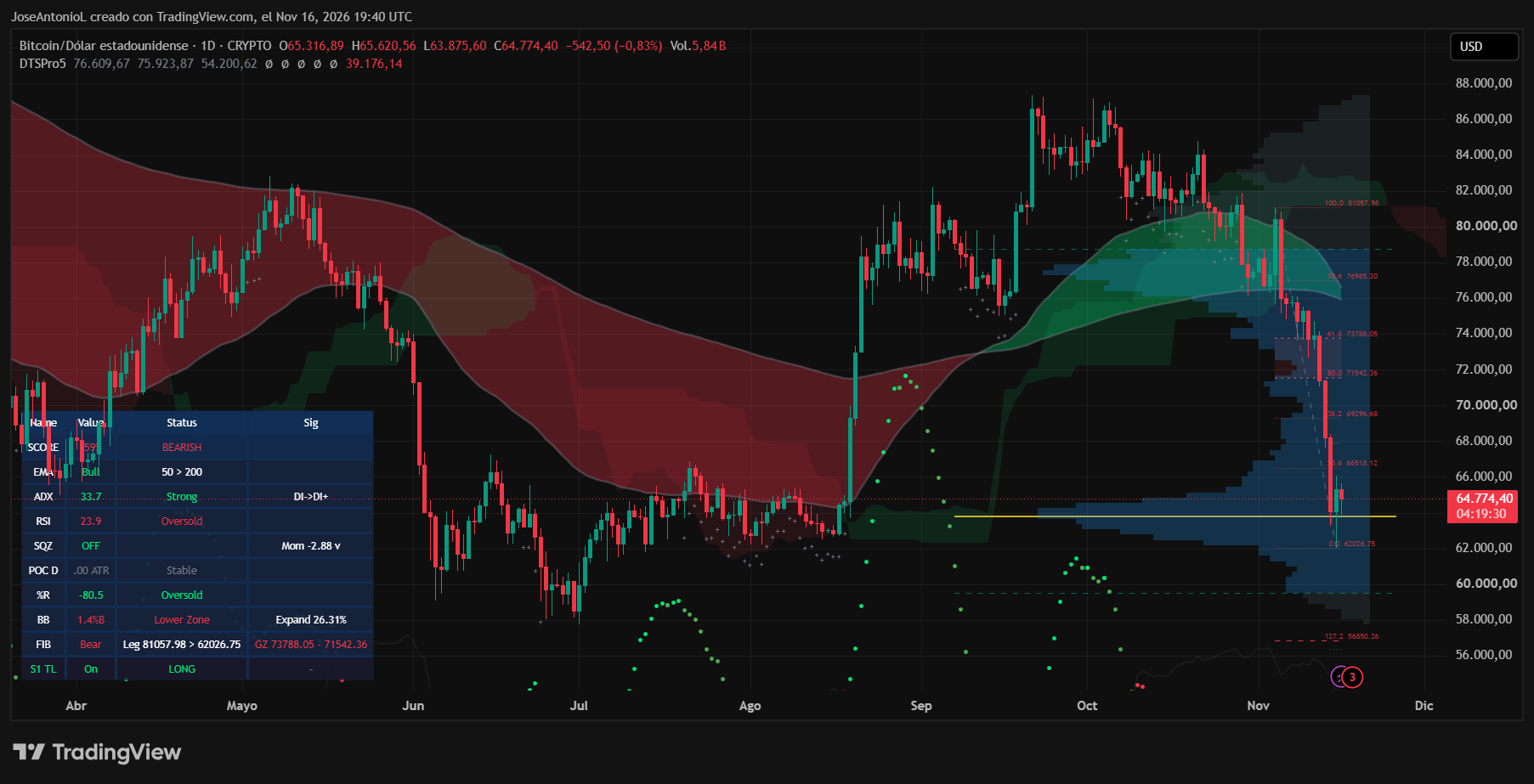
What the charts did—and did not—show
Bitcoin bounced after approaching the $62,000 area. At the time of the report, its daily Relative Strength Index was near 24, in oversold territory, while the Average Directional Index was above 33 and bearish directional pressure still dominated. Weekly RSI was near 38—weak, but not oversold. An oversold reading is not, by itself, evidence that a decline has ended.
The chart put potential resistance around $66,500–$67,200, then $69,300, based on Fibonacci levels. A decisive move below $62,000 would bring $60,000 back into focus. The report also noted significant downside exposure in options, with $50,000 puts among contracts drawing recent activity ahead of the November 27 expiration. Those levels describe what traders were watching, not where Bitcoin was certain to go. Monday’s ETF flows and demand for downside protection remained unresolved at the time of reporting.