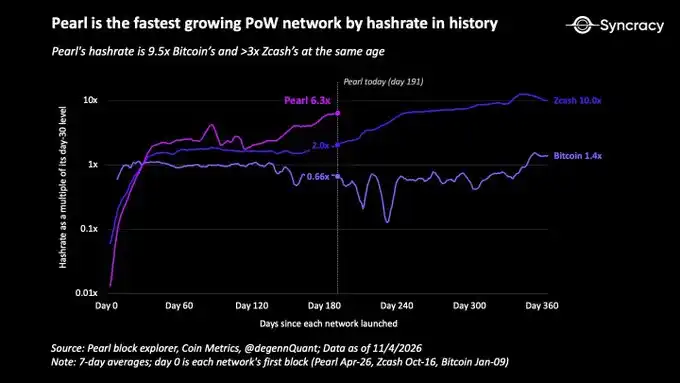
On November 19, 2026, crypto investment firm Syncracy argued that Pearl could turn AI inference into a source of proof-of-work security—and eventually draw more computing and energy resources than Bitcoin. Syncracy disclosed that it had built a substantial PEARL position over the preceding two quarters. Its forecast is an investment thesis from a holder, not an established outcome.
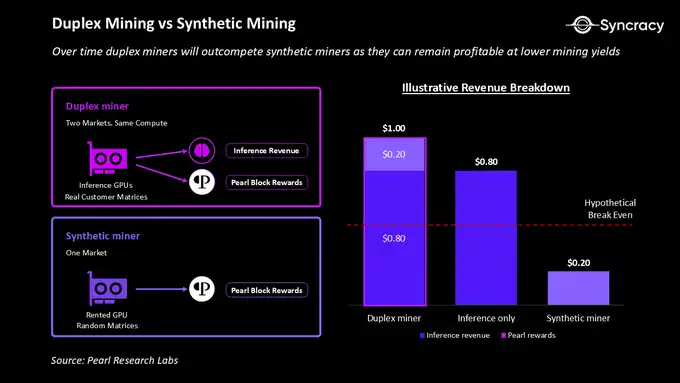
The proposed advantage is a second revenue stream for AI operators. Pearl is designed so that matrix multiplication used in inference can also produce mining work. If an operator is already paid to process customer requests, mining rewards could make that workload more profitable without requiring a separate, dedicated mining operation. Syncracy says Pearl grew out of 2025 research by co-founders Omri Weinstein and Ilan Komargodski; they launched the network with Idan Sugarman the following year.
There is an early commercial example, but not yet proof of adoption at scale. Together AI has introduced an inference service that processes customer requests while mining PEARL, using the mined tokens to subsidize inference prices. Syncracy said that, as far as it had verified, Together had not yet sold its mined PEARL at scale. That observation does not settle whether early token issuance will create selling pressure later.
The adoption test
At the time of Syncracy’s account, Pearl mining used integer matrix multiplication. Modern AI data centers increasingly use lower-precision formats such as FP8. Based on its conversations with miners, Syncracy estimated that roughly 80% of Pearl mining still ran on consumer GPUs, mostly in China—not on paid inference workloads in large data centers.
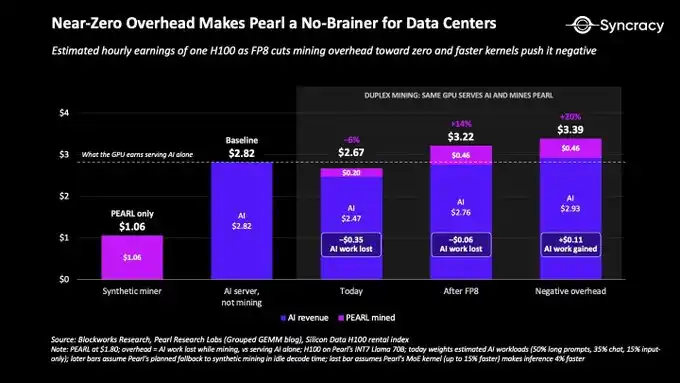
A planned FP8 upgrade is central to changing that mix. Syncracy expects it to reduce mining overhead from about 5% to near zero and make enterprise inference hardware more competitive. Neither the resulting overhead nor broad uptake by inference providers had been demonstrated in the account. The consequential measure is how much post-upgrade mining work actually comes from inference tasks customers are paying for, rather than computation performed solely to earn block rewards.
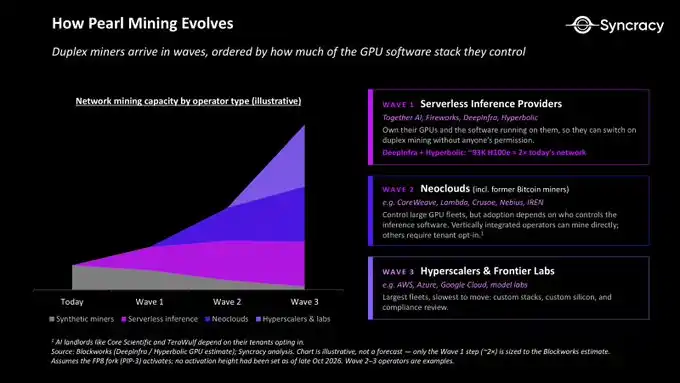
Syncracy also cited a Blockworks estimate that DeepInfra and Hyperbolic together controlled about 93,000 H100-equivalent GPUs that could mine after the upgrade. That is potential capacity, not a report that those GPUs had joined Pearl. Syncracy’s suggested path from inference providers to major cloud platforms and AI labs likewise remains a projection.
More computing is not automatically more security
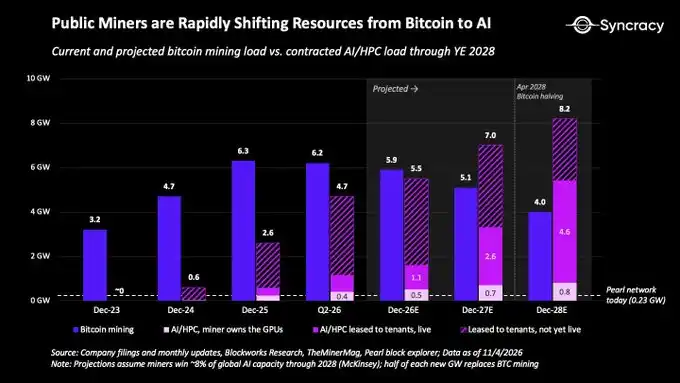
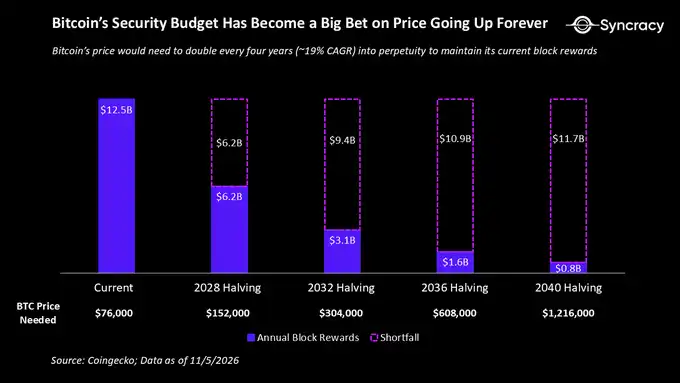
Syncracy frames Pearl against pressure on Bitcoin miners: block subsidies halve roughly every four years, while AI offers another use for data-center power. It cited figures indicating that up to 44% of public miners’ power capacity was contracted for AI and high-performance computing during 2026–2028. Its calculation that Bitcoin’s price would need to double every four years—about 19% annual compounded growth—to maintain the dollar value of subsidy income assumes fees do not make up the difference. That is a scenario, not evidence that Bitcoin’s security has already failed.
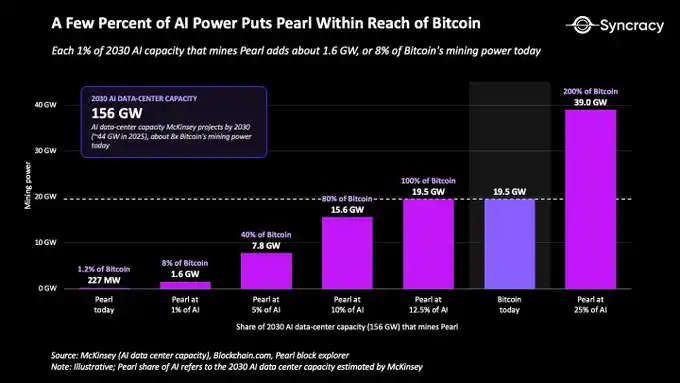
Syncracy calls the possible day Pearl overtakes Bitcoin in computing and energy resources devoted to network security “P Day” and suggests it could arrive before 2030. The networks perform different computations, so their raw hash-rate figures cannot simply be compared. Even a resource comparison would leave a critical question: Bitcoin’s mining ASICs have limited alternative uses, while GPUs can be redirected elsewhere. Syncracy acknowledges that this weakens the economic penalty for attacking Pearl and could make resource totals overstate its security.
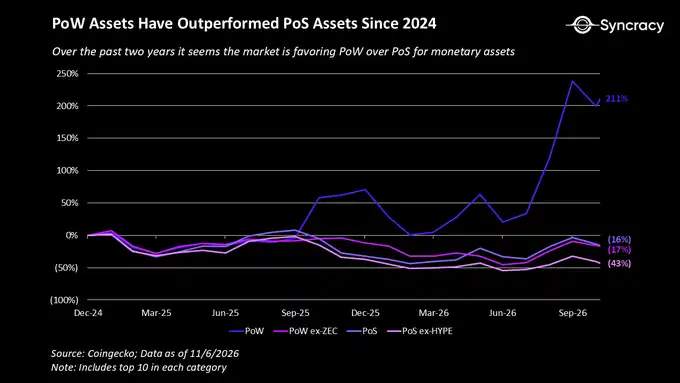
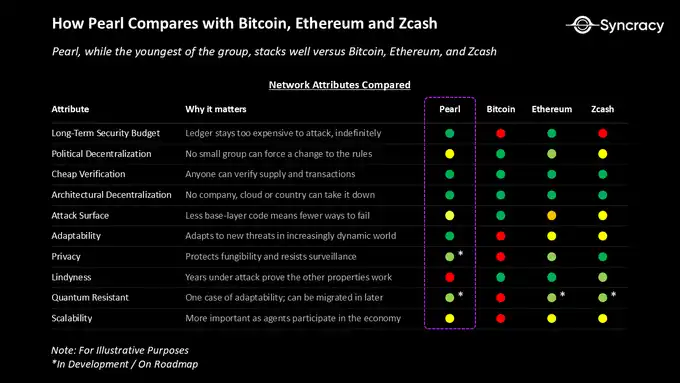
Other parts of the pitch are also unfinished. Syncracy says Pearl had already made quantum-resistant support available on mainnet, but native privacy was still under development, with a possible 2027 launch. A proposed market for future AI computing capacity—in which PEARL could be used for settlement—had not been finalized. Keeping Pearl’s mining compatible with changing AI formats may also require repeated protocol upgrades; Syncracy reported four forks since April 2026 and another planned for FP8.
Syncracy argues that even a PEARL valuation amounting to a low- to mid-single-digit percentage of Bitcoin’s market value would represent a strong return from its then-current starting point. That promotional benchmark is separate from the evidence available in November 2026. Together AI’s service shows the dual-revenue idea can be offered as a product; whether paid inference can supply Pearl with substantial, durable security at negligible extra cost remained unresolved.