
A familiar bear-market theory says major exchanges need altcoins to recover because they need the trading fees. In an article published on November 16, 2026, TechFlow writer Xiaobing argued the opposite: exchanges may increasingly be able to earn fees from contracts tied to stocks, commodities and other traditional assets instead. The figures cited make that a narrative worth examining, not a settled verdict on altcoins.
What the reported figures show
Citing Datawallet and on-chain statistics, the article said Hyperliquid recorded $216.9 billion in perpetual-contract volume over a 30-day period as of the end of the third quarter of 2026. It separately reported more than $548 billion in cumulative trading across builder-operated stock, commodity and index markets. Those are different time periods and should not be compared as though they measure the same month. The article said non-crypto assets accounted for roughly 30% of trading volume, briefly reaching 51% during July, while real-world assets’ share of open interest rose from 6% at the start of the year to 24%.
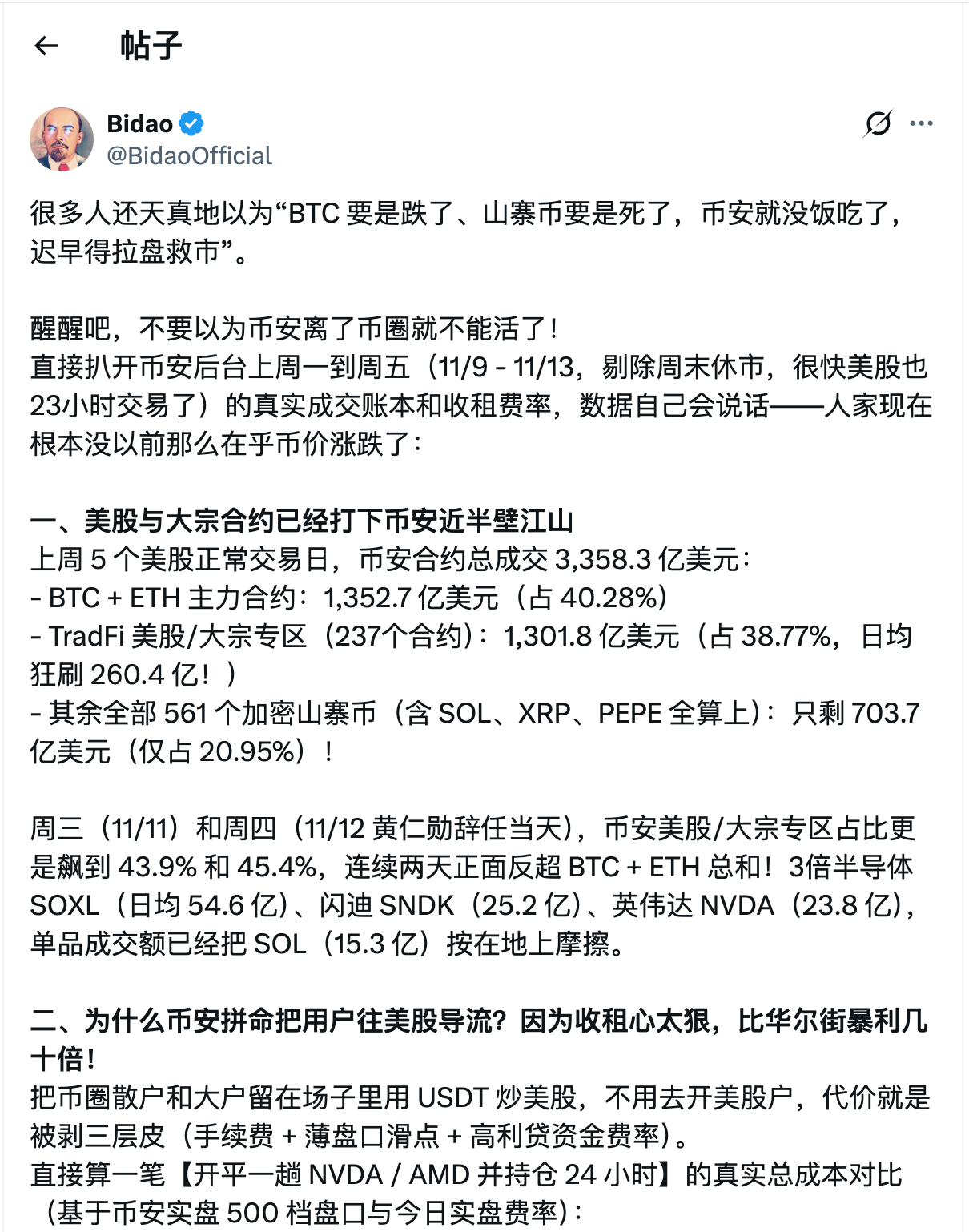
For centralized exchanges, the article cited a CryptoQuant report that put Binance’s tokenized-stock trading volume at about $676 billion from late February through late October 2026. It also cited crypto commentator Bidao’s tally for November 9–13: of $335.83 billion in Binance futures volume, BTC and ETH contracts represented 40.28%, a stock-and-commodity section 38.77%, and 561 other cryptoassets 20.95%.

The claim the numbers cannot settle
The article’s conclusion—that exchanges no longer need altcoins—is an interpretation, not a demonstrated change in exchange policy or a forecast the cited trading snapshots can prove. The figures suggest substantial activity in traditional-asset-linked products on crypto trading platforms during the stated periods. They do not, on their own, establish that exchanges have abandoned altcoins or that altcoin markets cannot recover.