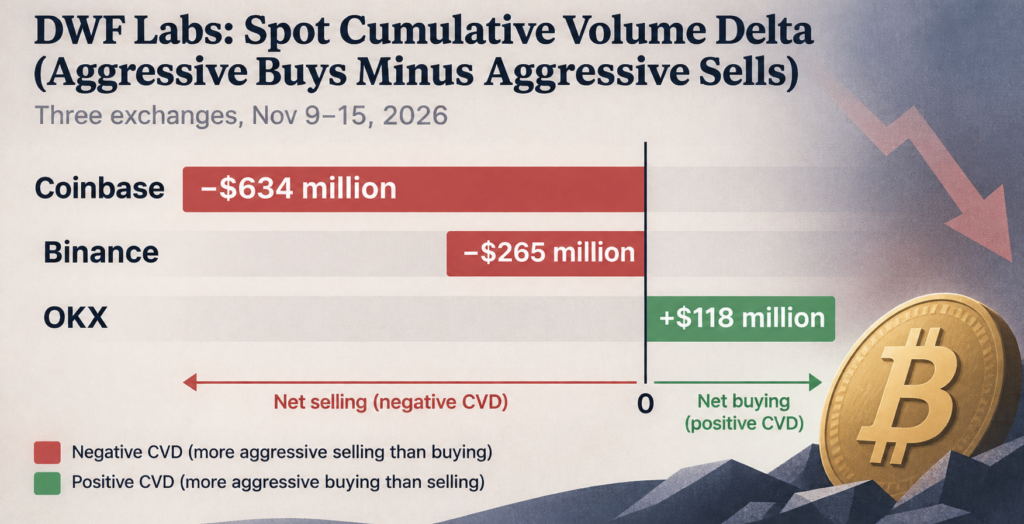
In a November 17, 2026 account of the Bitcoin sell-off, the author pointed to reports from DWF Labs and 10x Research to argue that selling through U.S. markets and weekend liquidations were central to the decline. The figures describe where trading pressure appeared; they do not identify every seller or prove a coordinated effort to trigger stop-loss orders.
Where the spot selling appeared
DWF Labs measured spot cumulative volume delta—the value of aggressive buys minus aggressive sells—across three exchanges for November 9–15. It reported negative $634 million on Coinbase, negative $265 million on Binance and positive $118 million on OKX. Coinbase accounted for about 80% of the net selling across those three venues.
The article also reported five consecutive days of net outflows from U.S. spot Bitcoin ETFs, totaling $1.065 billion for the week. It put spot Ether ETF outflows at $399 million and said they had reached seven consecutive trading days by Friday.
Those figures are consistent with pressure in U.S.-linked markets. But Coinbase trading data and ETF flows alone cannot establish that U.S. institutions or ETF-related investors made all, or most, of the identified spot sales. Rumors naming other sellers were not substantiated by the figures presented.
What the weekend decline does—and doesn’t—establish
10x Research characterized the weekend drop as having the features of a “stop-loss hunt”: falling prices triggered stops around the starting point of August’s rebound. Its proposed explanation was that thinner weekend liquidity, absent professional investors and limited access to bank transfers for additional margin could intensify the move. That is an interpretation of the price action, not proof of who initiated the selling or why.
The article cited $5.77 billion in market-wide liquidations over the period, including $4.69 billion in long positions—about 81% of the total. It also said 10x viewed $62,000–$63,000 as a possible base for the year, while warning that large holders were still selling and its trend model had not turned. DWF’s $58,000–$62,000 range was presented as a next support reference, not a confirmed bottom, after the article described a loss of the $68,000 weekly level.
The author further suggested that a possible December Federal Reserve rate increase, rather than a cut, could weigh on risk assets, citing recent tightening remarks by Collins. That was a macroeconomic scenario in the account, not an announced Fed decision. The measurable flows, the proposed stop-loss mechanism and the rate outlook are different kinds of evidence; combining them does not settle who sold Bitcoin.