
In reporting dated November 17, 2026, crypto research firm Kaiko said the stablecoin market had lost about $12 billion in value over the preceding 30 days—the fastest contraction since the 2022 Terra-Luna collapse. The reported withdrawals matter for Bitcoin traders because stablecoins often serve as cash-like balances on trading venues. They do not, by themselves, establish why holders left.
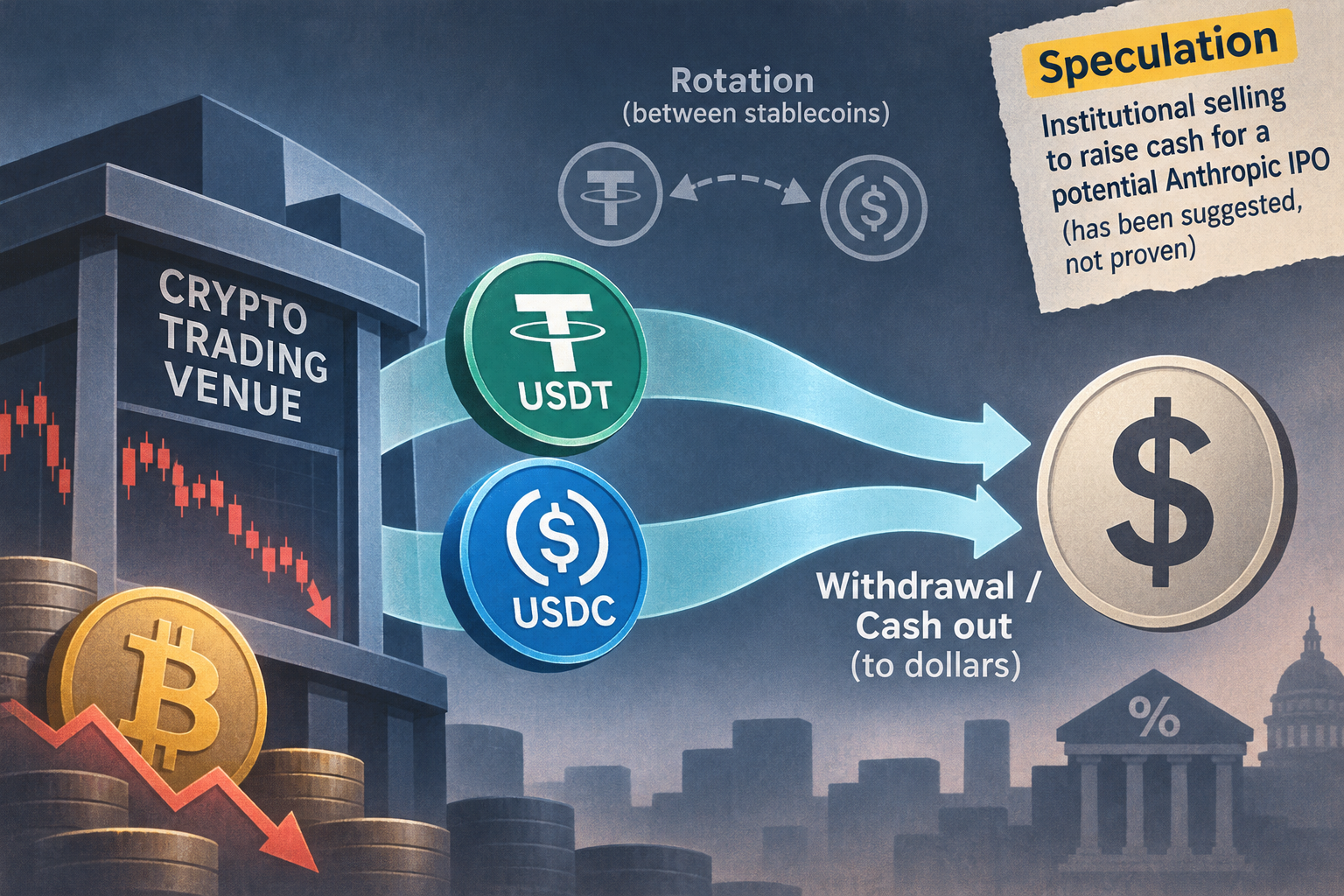
Kaiko said USDT and USDC accounted for 90% of the 30-day decline. Its research head, Anastasia Melachrinos, said both had shrunk by roughly 4% without losing their dollar pegs. She interpreted that parallel decline as evidence of holders cashing out into dollars rather than switching from one stablecoin issuer to another. That is an interpretation of the flows, not a transaction-by-transaction accounting of every holder’s destination.
Glassnode researcher Sean Rose put the combined net decline in USDT and USDC balances on centralized exchanges at about $26.7 billion since April 2026. Glassnode also recorded a stablecoin-market peak of $312.6 billion on April 17, compared with roughly $284 billion at the time of the November report. Rose contrasted the simultaneous declines in USDT and USDC with the 2022–23 contraction, when he said the market shrank by about 35% while USDT expanded.
The report described Bitcoin as down more than 20% over the preceding month. It said a fall of as much as 8% over several hours on the preceding Saturday brought the price to its lowest level since July, amid margin calls and forced liquidations. Thinner trading liquidity could magnify such moves, but the reported stablecoin figures alone cannot establish the cause of that sell-off.
One proposed explanation deserves an especially bright label: speculation. Tagus Capital suggested that institutions might be selling crypto assets to raise cash for an anticipated Anthropic IPO. Its report compared Bitcoin ETF outflows with a purported earlier SpaceX-related fundraising pattern and cited a Hyperliquid perpetual-market valuation near $1.8 trillion, a purported filing-range ceiling of $1.4 trillion and possible fundraising of $100 billion. These are Tagus Capital’s claims, not evidence in the supplied report that an Anthropic listing was scheduled or that IPO preparations caused the stablecoin withdrawals. The report itself gives inconsistent relative timing for the proposed listing.
The source also raised rising Treasury yields, a stronger dollar, post-election policy uncertainty and a reported Binance hack as possible pressures. None is isolated as the cause of the outflows. The narrower takeaway is substantial, concurrently reported declines in the two largest stablecoins and in exchange balances; the more dramatic story about where that capital went remains unproven.