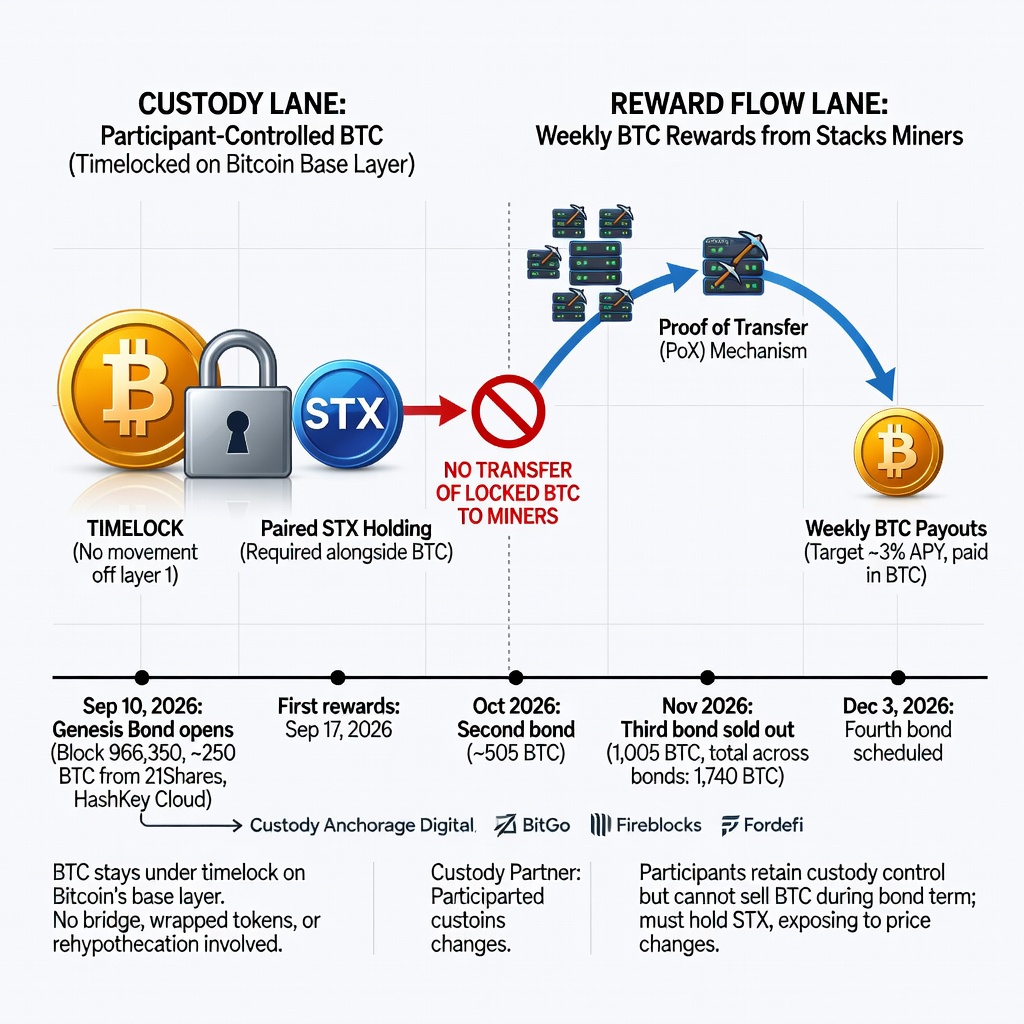
Stacks says institutions can earn weekly BTC rewards without lending out their bitcoin or moving it off Bitcoin’s base layer. By November 28, 2026, its third institutional staking bond had sold out. The distinction for participants is between custody and liquidity: they retain control of their BTC, but cannot sell it during the bond term. They must also hold STX, the Stacks token, alongside it.
Who pays the rewards?
The BTC stays under a timelock on Bitcoin. No bridge or wrapped token is involved, and the coins are not reused as collateral for other loans. Stacks miners supply the rewards through Proof of Transfer, a mechanism that has distributed more than 4,200 BTC since its activation in January 2021. The bonds give institutions access to that existing reward stream under the PoX-5 upgrade, which went live on July 30, 2026.
The roughly 3% annual percentage yield is a target, not a measured return for the bonds. Participants receive payouts in BTC, so they need not sell STX to collect their rewards. The requirement to pair BTC with STX still exposes them to changes in the token’s price.
What the first three bonds drew
The Genesis Bond opened on September 10, 2026, at Bitcoin block 966,350 and drew approximately 250 BTC from participants including 21Shares and HashKey Cloud. The first rewards reached wallets on September 17. The second bond attracted around 505 BTC in October, and the third sold out at 1,005 BTC in November. The reported total across the three offerings was 1,740 BTC; the first two offering figures were approximate.
Stacks lists Anchorage Digital, BitGo, Fireblocks and Fordefi as institutional custody partners. BitGo integrated the service in November 2026, allowing existing institutional clients to stake through its platform.
A fourth bond was scheduled to start on December 3, 2026. Stacks also expects to introduce self-custodial BTC borrowing against staked positions in 2027. That would give participants a way to access liquidity during the lock, but it was not a feature of the first three bonds.