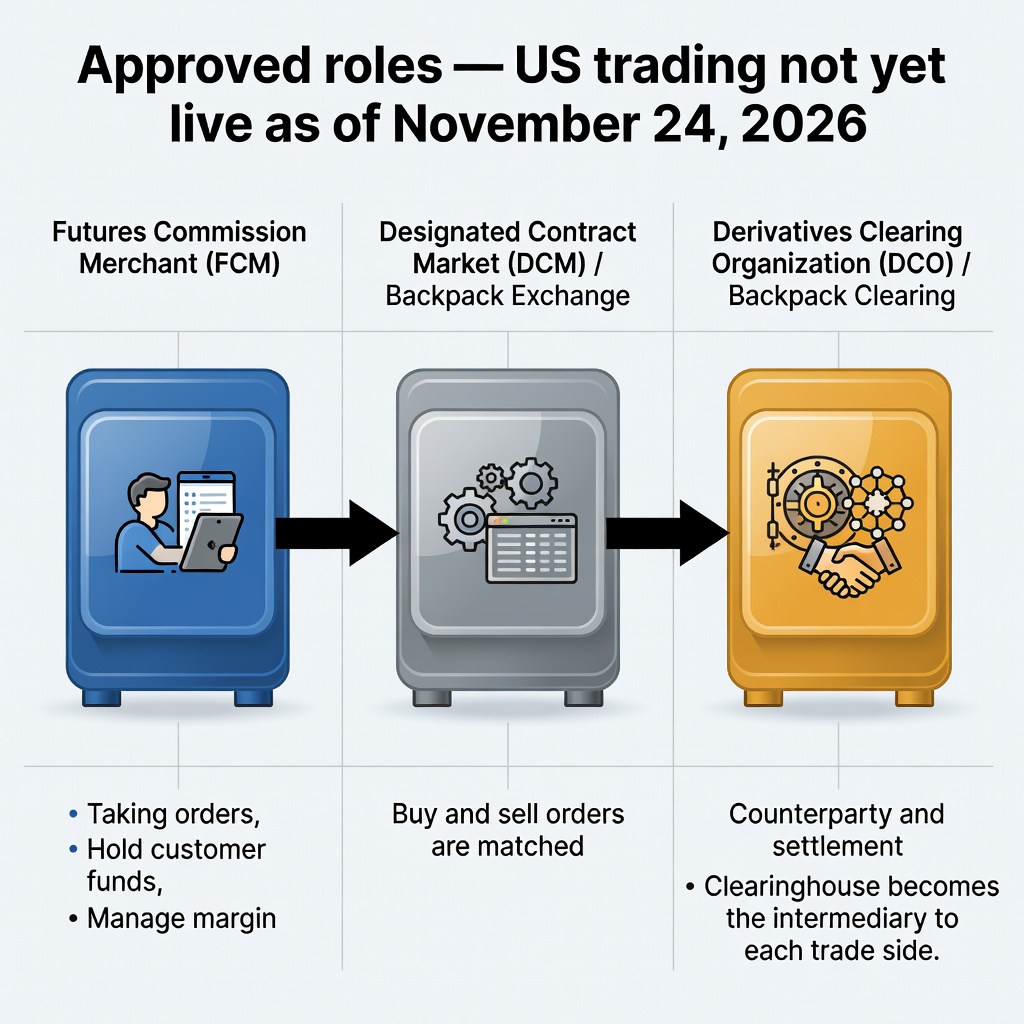
The Commodity Futures Trading Commission approved two Backpack affiliates to operate a US derivatives exchange and a clearinghouse. A separate brokerage approval gives Backpack a way to take customer orders as well as match and settle trades. As of November 24, 2026, at 12:38 p.m. EST, US trading had not begun; prospective customers could only join a waitlist.
What each approval covers
TokenPost first reported the two CFTC approvals, which went to separate legal entities three days apart:
- November 13 — clearing: TLD Clearing, operating as Backpack Clearing, registered as a derivatives clearing organization. The clearinghouse becomes the counterparty to each side of a trade, so a buyer or seller does not depend on the other trader to pay.
- November 16 — trading: TLD Markets, operating as Backpack Exchange, received designation as a designated contract market. It can run the venue where buy and sell orders are matched.
CFTC Chairman Michael Selig publicly announced both approvals on November 16 and described them as evidence that the US remains open to financial innovation. On November 18, the National Futures Association approved Backpack as a futures commission merchant. That third approval covers the customer-facing role: taking orders, holding customer funds and managing margin.
What the approvals do not establish
Research cited in the reporting said Backpack could use blockchain infrastructure for both execution and clearing. The researchers described the designation as a first for a firm using such infrastructure; that characterization was theirs, not the CFTC’s.
The research also outlined possible products: leveraged perpetual futures that trade around the clock and have no expiry date, and an account in which traders could use both fiat and crypto as collateral. A single global order book could, in theory, match US orders with non-US orders. None of those features was live in the US as of November 24.
Backpack began as a non-custodial wallet on Solana before expanding into exchange and derivatives services. It holds licenses from Dubai’s Virtual Assets Regulatory Authority and operates under the European Union’s MiCA and MiFID II frameworks. Its reported cumulative trading volume exceeded $447 billion across more than 150 countries, not on the still-unopened US venue. Backpack’s US president, Mark Wetjen, is a former CFTC commissioner.