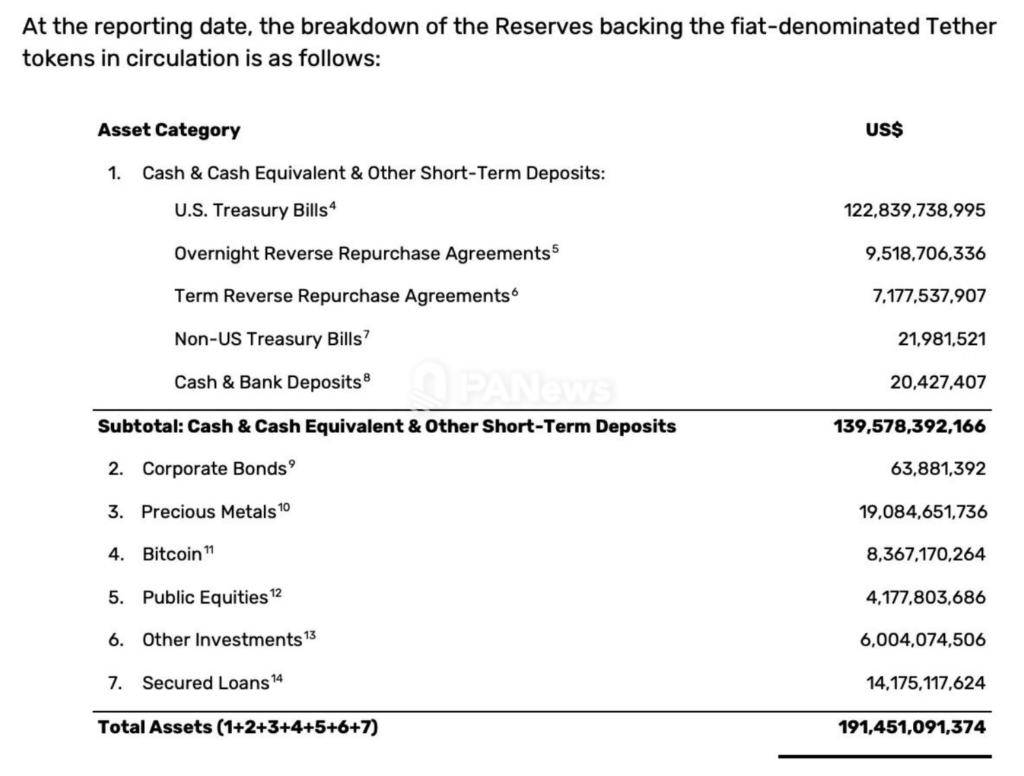
In its November 23, 2026 report, PANews examined a familiar bear-market concern: whether declines in gold and Bitcoin could erode Tether’s reserve cushion and put pressure on USDT. The concern is a risk scenario, not evidence that USDT had become undercollateralized or that a redemption crisis had begun.
Tether’s third-quarter reserve report put assets at approximately $191.45 billion and liabilities at $183.5 billion, leaving a reported $7.95 billion surplus. Its holdings included roughly $19.08 billion in gold and $8.367 billion in Bitcoin. CEO Paolo Ardoino had also recently said the company held more than 150,000 BTC.
Crypto analyst @fozzydiablo argued that falling prices across Bitcoin, gold and equities could consume the surplus. The analyst cited a Bitcoin decline of more than 30% and a gold decline of about 15%, and suggested that applying a further 15–20% discount to assets such as loans could bring Tether close to insolvency. That is the analyst’s stress scenario, not a finding that Tether’s current reserves have fallen below its liabilities.
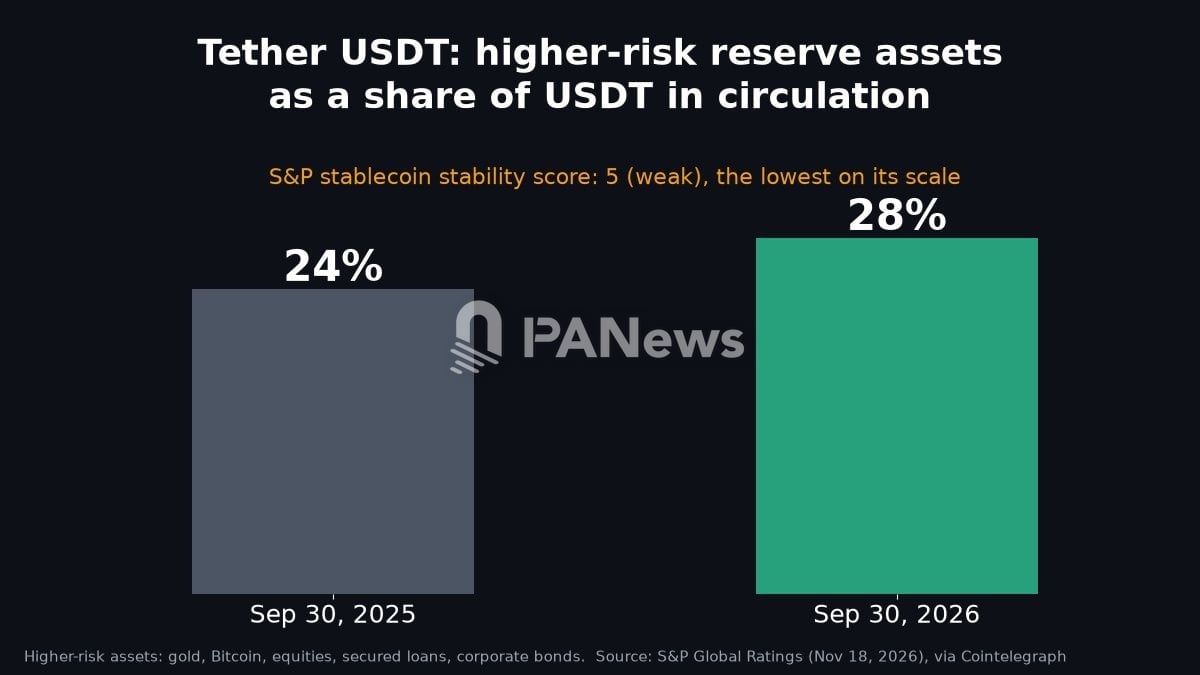
S&P Global Ratings assigned Tether’s ability to maintain its dollar peg a 5, the lowest grade on its five-point scale. S&P said riskier assets had risen to 28% of USDT in circulation as of September 30, from 24% a year earlier, citing increased gold holdings and $4.2 billion in new publicly traded equity exposure. It warned that a steep fall in those assets could exhaust the surplus in an extreme case. Tether disputed the assessment, arguing that S&P’s framework—not its reserves—was the problem.
A separate on-chain figure needs careful reading. The report said Tether had burned 8 billion USDT over the preceding 20 days, but those tokens were unissued treasury inventory, not customer-held USDT redeemed for dollars. Their destruction did not itself require a cash payout.

The report also noted counterweights to the stress case: about 73% of Tether’s reserves were in liquid assets such as short-term U.S. Treasuries and repurchase agreements, and the company reported $4.5 billion in net operating profit for the first three quarters of 2026. Those figures do not eliminate risk, but they matter when distinguishing a shrinking reserve cushion from an immediate inability to meet redemptions.
Crypto researcher CM likewise saw possible undercollateralization if gold and Bitcoin fell further, while judging a near-term company-level payment crisis relatively unlikely given Tether’s earnings. CM cautioned that fear could still prompt holders to swap USDT for other stablecoins, causing a temporary market-price deviation from its peg even without a redemption failure. The unresolved question is how Tether’s reserve values and holder behavior would change under a sustained sell-off—not whether a widely shared stress calculation has already proved a crisis.