Reported on November 19, 2026, at 16:12 (UTC+8). Figures and project plans below reflect that reporting date, not a current status check.
Pearl, Ambient, Flop, Nockchain, Gonka and Antseed approach the same proposition from different directions: can AI computation support a crypto network or marketplace? The distinction is whether a system proves that computation happened—or shows that a customer paid for useful work.
Compute is not the same as demand
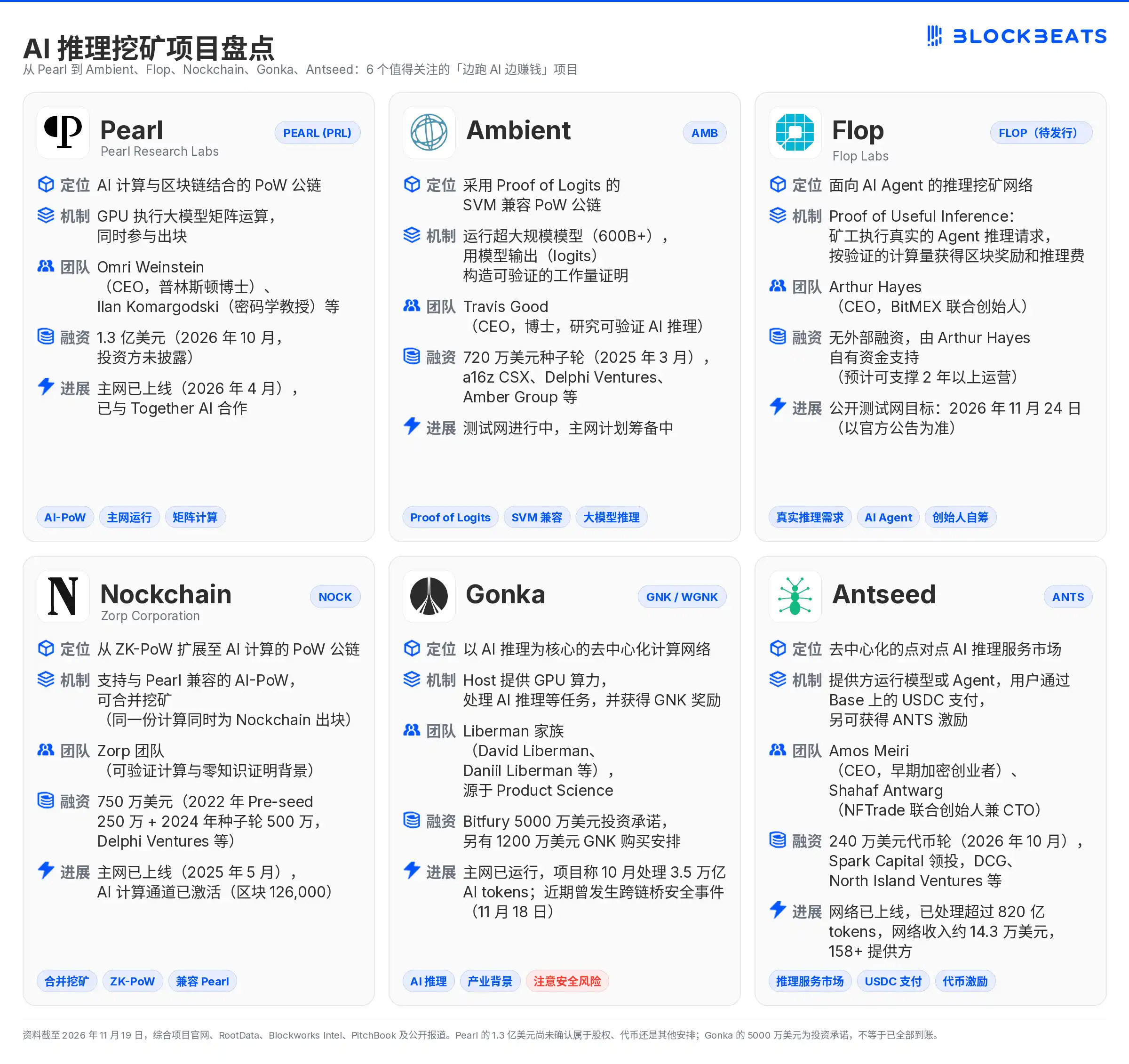
Pearl replaces conventional proof-of-work hashing with noisy matrix multiplication and a compact Plonky2 proof. Its protocol verifies the computation, but a miner can earn rewards by generating random matrices without serving a paying AI customer. A June 2026 sample of 8,012 mining processes suggested that H100 GPUs accounted for just 3.1% of inferred computing power, with H200 and B200 GPUs together at roughly 0.5%. A Gemma-4 31B endpoint on Together AI was the main publicly visible paid service cited in the report. As of November 19, Pearl’s reported network power was about 106.38 EH/s, while PRL was quoted at $2.34 with a circulating market capitalization near $897 million. Its proposed FP8 upgrade, PIP-3, remained a draft. An October 25 transaction of $130 million had not been confirmed as either VC equity or token financing.
Ambient focuses instead on verifying that a specified model produced an output. Its Proof of Logits design commits to each generated token’s logits and lets validators recompute a randomly selected portion. Ambient offered APIs for three models, but its website’s figures of 134 billion tokens processed and 126,000 users had not been updated since June. The chain remained on testnet; token documentation said the token had not been announced, despite mining-page language referring to AMB payments. Ambient raised a $7.2 million seed round in March 2025. An operating API does not, by itself, establish that a decentralized network is delivering that service.
Flop proposes a more direct demand test: an AI agent submits an inference order before a miner bids to perform it. Its design retains an execution record for potential checks within seven days, with a possible loss of the miner’s deposit for cheating. Arthur Hayes became Flop Labs CEO in August 2026 and, according to the project, funds it without external equity or token financing. Hayes said on November 13 that a testnet would launch on November 24. At the time of the report, the website showed conflicting schedules, two earlier plans had missed their dates, and no token had been issued. The white paper’s proposed reward split also differed from the then-current design.
Nockchain introduced an AI-proof-of-work channel compatible with Pearl’s matrix multiplication, allowing the same computation to participate in mining on both chains. As of November 19, that channel was reported at 16.71 ExaMAC/s, up from 71 PetaMAC/s, and accounted for 68.75% of blocks in the latest window. But the work was still matrix multiplication, not customer-requested conversational inference. The top five entities controlled about 79% of block production. Its developer Zorp Corporation had raised $7.5 million across two rounds; that was company financing, not funding for the protocol treasury.
Model use, payments and asset risk
Gonka requires hosts to run approved models. Its dashboard showed about 1,560 GPUs and 135.9 billion tokens processed daily as of November 19—about 17.9 times the comparable daily Ambient figure cited in the report. Those tokens cannot all be counted as paid inference. Bitfury’s support included an approximately $12 million GNK community-pool token purchase arrangement and a $50 million investment commitment announced in December 2025; a commitment is not proof that all funds were received.
Gonka also faced a separate asset-layer problem. On November 18, approximately $1.05 million in assets left its cross-chain bridge, and unbacked WGNK appeared. K3’s sBOLD vault lost about $3.43 million the same day, but the two events should not be treated as one attack without verification. After the bridge was paused, GNK and WGNK traded at sharply divergent quoted prices, leaving no reliable unified token price in the figures reported.
Antseed takes a different route: a peer-to-peer AI-service marketplace rather than its own consensus chain. Providers advertise through BitTorrent DHT; buyers connect directly and settle through USDC payment channels on Base. The stated protocol fee is 4%. Its own Antscan explorer reported, as of November 19, about 980 billion tokens processed, including 669 billion paid tokens, 774,800 settlements and $405,000 in cumulative transaction volume. The homepage showed lower figures, including 82 billion tokens and $143,000 in transaction volume. The discrepancy needs explaining. Antscan also showed approximately 145 million ANTS minted, while the homepage listed zero in circulation; minting and circulation are not interchangeable.
Image-label correction: If an accompanying Antseed graphic calls the homepage’s $143,000 “network revenue,” that label is wrong. The source describes it as transaction volume. Applying the stated 4% fee to Antscan’s higher $405,000 volume yields an estimate of about $16,200 in protocol fees—not confirmed revenue.
These projects provide different kinds of evidence: completed computation, model-output verification, planned order matching or reported marketplace settlements. None of those measures should be silently substituted for another, particularly when assessing claims of paid AI demand.